
 EN
EN
 AR
AR
 BG
BG
 HR
HR
 DA
DA
 NL
NL
 FR
FR
 DE
DE
 EL
EL
 HI
HI
 IT
IT
 JA
JA
 KO
KO
 PT
PT
 RU
RU
 ES
ES
 SV
SV
 TL
TL
 ID
ID
 SR
SR
 SK
SK
 UK
UK
 VI
VI
 ET
ET
 HU
HU
 TH
TH
 TR
TR
 MS
MS
 GA
GA
 BE
BE
 HY
HY
 KA
KA
 LO
LO
 LA
LA
 MN
MN
 NE
NE
 SO
SO
 MY
MY
 KK
KK
 UZ
UZ
High Flow vs Multi Extruder: Speed, Cost, Redundancy
High-flow vs. multi-extruder is a choice between two ways to deposit more volume per hour: one wide bead moving fast, or a second and third melt path stacked onto the same frame. This comparison is written for the buyer signing the order — what each route costs, what it saves, and what happens to a two-day job when one nozzle clogs.
What Each Route Actually Is
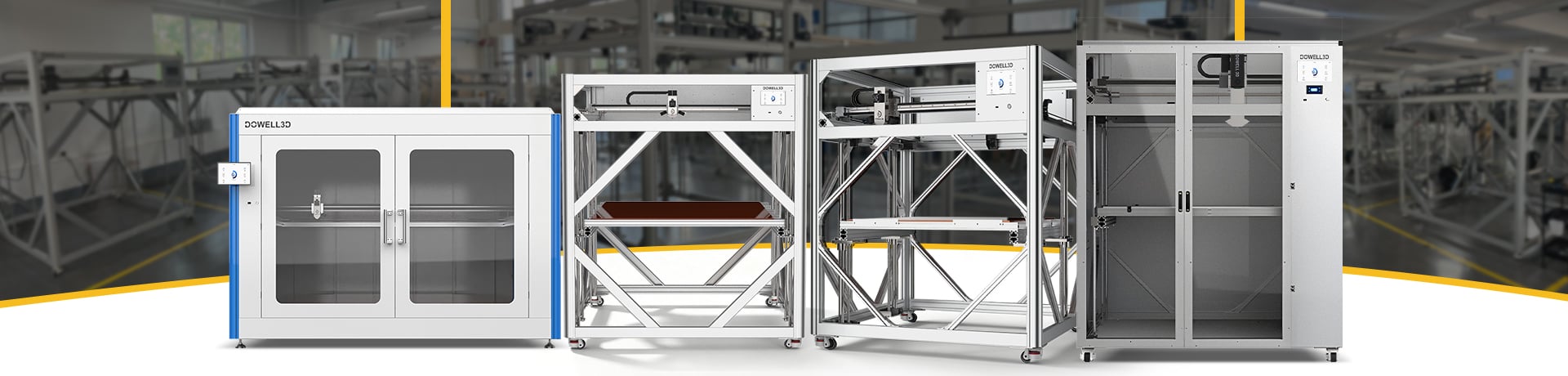
Single-stream means one hot end or screw path, one wide bore, one bead at a time. Our own line takes that route: a single extruder per machine, from a 0.4mm bore up to a 3.0mm screw on the pellet machines, where one path is rated at 4,000- 5,000 grams an hour.
A multi-extruder machine puts several independent melt paths on one gantry. They can be used in three different ways: as parallel output on a single part, as role separation, or as a spare sitting on standby. That is the dual extruder vs. single extruder question in its industrial form — not which one prints better, but which failure mode your production can absorb.
Speed: What Extra Hardware Actually Buys
Deposited volume per hour is bead cross-section multiplied by travel speed, and the ceiling on that product is melt capacity. A wider bore raises the first term without adding a single component, which is why a high flow extruder for large parts is usually the cheapest speed in the building. Merging two melt streams into one nozzle doubles the flow carried by a single bead, and the same idea extends further as melt capacity per bead grows, so this route still has headroom.
A second head only adds real speed when the job can be split across heads: mirrored left and right parts, batches of small brackets, flat plates that fit side by side. On one large continuous body, the second head has nothing to print while the first works, and it adds mass both heads must carry.
What the Extra Path Costs You
The single-stream route is priced as one melt path, one set of drivers, one calibration routine. A multi-head machine duplicates all three, and that is where the 3d printer tool changer cost sits. Recurring costs lean the same way: more heads means more nozzles, more thermocouples, and more spares on the shelf.
Wear deserves its own line. Abrasive filament nozzle wear accelerates with filled polymers and with bore size, so a shop pushing filled filament or pellets through 3.0mm nozzles should treat nozzles as a consumable. Fewer heads means fewer nozzles to watch.
Redundancy, and Why Shops Fund It
Uptime, not speed, is what funds multi extruder 3d printer redundancy. On a machine running thirty-hour builds, a clogged nozzle costs the part plus everything already deposited. A standby path, or a relay arrangement where the second path takes over, turns that loss into minutes.
The economics are blunt: a spare path is what makes unattended printing possible on a Friday. Without one, the choice is either to babysit the machine or to accept the risk.
Polymers and Supports
Role separation is the other half. Industrial multi-material printing usually means one polymer for the body and a second for support, colour, or a wear surface — and dedicated support pays off on geometry that would otherwise need handwork, because support material removal on large prints is the task that quietly eats the hours. From the other direction, a core-and-sheath nozzle that places two polymers inside a single bead solves the same problem without a second head.
When Each Route Wins
The single-stream machine is the right buy when parts are large, few, and mostly one polymer — when deposited volume, not head count, stretches the schedule. A multi-head machine earns its place when a part needs a dedicated support polymer, when two polymers must meet inside one body, or when a service call costs more than the second head did. Both answers are legitimate; only one matches your part mix.
Questions Buyers Ask Before Signing
Is a second extruder automatically faster?
Only when the job can be split across heads, and that set is smaller than most buyers expect. Counting the jobs that can genuinely run in parallel — not the parts on the drawing — is what settles how many extruders do I need.
Does a high flow path hurt surface quality?
It changes the surface rather than ruining it. A wide bore lays a thicker bead, so layer lines read as ribbing and fine detail moves out of reach. High flow hotend surface quality is decided by nozzle and layer height, and a finer bore on the same machine brings detail back when a part calls for it.
What does redundancy actually save?
The cost of a failed long job, priced against scrap value. A spare path is insurance, and it is worth funding exactly when one failure would cost more than the second melt path.
Can I add a second head later?
The frame, wiring, and controller on most single-stream industrial machines are sized for one path, so the answer is no. If parallel heads are part of the plan, that decision belongs in the purchase order, not in a future upgrade.
How much more floor space, power, and maintenance does a second path take?
Less than a second machine, but not nothing. Expect another heater and drive on the same supply, another calibration routine per polymer change, and another spares line. On a large-format frame the electricity is a rounding error next to the downtime the second path avoids.
Which one should I buy?
Match the architecture to the part mix, and the answer usually falls out on its own. A high flow 3d printer with a 3.0mm bore beats two fine-bore heads on a single large shell, because neither head has anything to do while the other works; two heads win on batches that need supports or two polymers.
Conclusion
Speed comes from bead cross-section and melt capacity. Cost scales with the number of melt paths and spares you own; redundancy is bought to protect long jobs. Score high flow vs. multi-extruder against those three, and the architecture follows from your part mix.
We have over 12 years of experience in the R&D, manufacturing, and export of large-scale industrial 3D printers. If you are unsure which printer to choose, simply share details about your intended use cases and models with us, and we will recommend the most suitable model for your needs.