
 EN
EN
 AR
AR
 BG
BG
 HR
HR
 DA
DA
 NL
NL
 FR
FR
 DE
DE
 EL
EL
 HI
HI
 IT
IT
 JA
JA
 KO
KO
 PT
PT
 RU
RU
 ES
ES
 SV
SV
 TL
TL
 ID
ID
 SR
SR
 SK
SK
 UK
UK
 VI
VI
 ET
ET
 HU
HU
 TH
TH
 TR
TR
 MS
MS
 GA
GA
 BE
BE
 HY
HY
 KA
KA
 LO
LO
 LA
LA
 MN
MN
 NE
NE
 SO
SO
 MY
MY
 KK
KK
 UZ
UZ
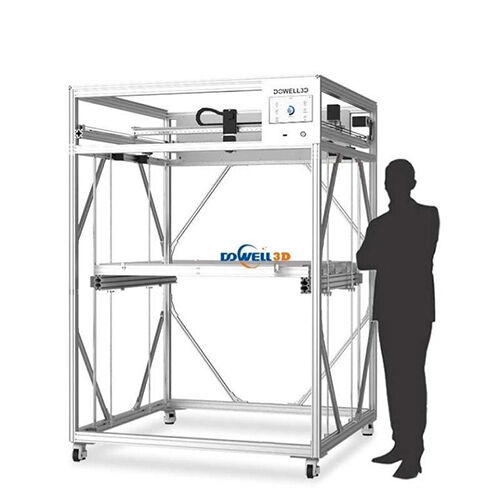
The face of industrial production is changing drastically. With industries working to be more efficient with full time-to-market and introducing part geometries that are increasingly complex, the limitations of usual processes come forward. In this chain of events, large scale 3D printing has become a key tool going from rapid prototyping to mass production technology for the in-line manufacturing of significant end products. For manufacturers that want to scale, big 3D printers are not just an innovative tool but instead a strategic necessity for high-volume production.
Enabling New Manufacturing Scale
The biggest issue with large-scale industrial printers is that they can create big parts in one continuous operation. With this feature, designers no longer have to design complex assembly jigs or plan the ordering and production of many parts that then need to be joined together in a labour intensive process. By creating such a large piece in a single shot, makers save time and limit the number of possible loose connections present in bundled pieces. And, as is often the case in sectors where part integrity and dimensional accuracy are a must, this is essential. Further, with the build envelope of such printers’ items that formerly were a multi part assembly may now be consolidated into a single optimized part, thereby making supply chains more straight forward and cutting overall product weight and material usage.
The Technology Driving Industrial-Grade Production
But not all big 3D printers are the same. In any high-volume manufacturing, the technology has to be stable and offer reproducible output for extended print times. That is where the need for advanced FGF (Fused Granular Fabrication) technology comes in. Introducing pellets serves as consuming of a cheaper and widely available material for such application, compared to traditional filament-based technologies. This significant reduction in material cost is a key enabler to high volume production. In addition to this, there is a close attention on certifying and testing advanced industrial grade materials, so the final parts have the necessary mechanical strength, thermal stability and chemical resistance to be used. It is this tech base, combined with a complex software system that provides total control over the print process, making industrial fabrication tools instead of simple prototyping machines.
Broad Applications Across Key Industries
Big 3D printer implications in high-volume situations are numerous and expanding. In automotive and aerospace industries, they are used to make large-scale tooling, jigs and fixtures that optimize assembly lines. They also allow the production of bespoke low volume interior parts as well aerodynamic fairings. Such an industrial 3D printers are ideal for forward-thinking design proofing, ultra-accurate model making and creating high quality fully functional prototypes across industries. They are also well-suited to making large replacement parts, machinery housings and more durable prototypes intended for production casting. The capability to move from a digital file to a physical part in days rather than months simply offers an almost unfair competitive advantage.
Partnering for a Seamless Integration
New equipment alone isn’t enough to embrace a new manufacturing technology. It requires a strong working relationship with an provider, but one that provides full support and deep expertise. It is imperative to have a competent technical team available to help the introduction of large-format 3D printing to workflows. That support covers the gamut from your first technical consult and configuring a machine for your specific production requirements to timely service that gets you up and running with minimal delay. This end-to-end solution empowers manufacturers to create the best product possible with big 3D printing in a way that was not previously possible – fast, reliable and maximizing the competitive advantages of large-scale freeform fabrication.