
 EN
EN
 AR
AR
 BG
BG
 HR
HR
 DA
DA
 NL
NL
 FR
FR
 DE
DE
 EL
EL
 HI
HI
 IT
IT
 JA
JA
 KO
KO
 PT
PT
 RU
RU
 ES
ES
 SV
SV
 TL
TL
 ID
ID
 SR
SR
 SK
SK
 UK
UK
 VI
VI
 ET
ET
 HU
HU
 TH
TH
 TR
TR
 MS
MS
 GA
GA
 BE
BE
 HY
HY
 KA
KA
 LO
LO
 LA
LA
 MN
MN
 NE
NE
 SO
SO
 MY
MY
 KK
KK
 UZ
UZ
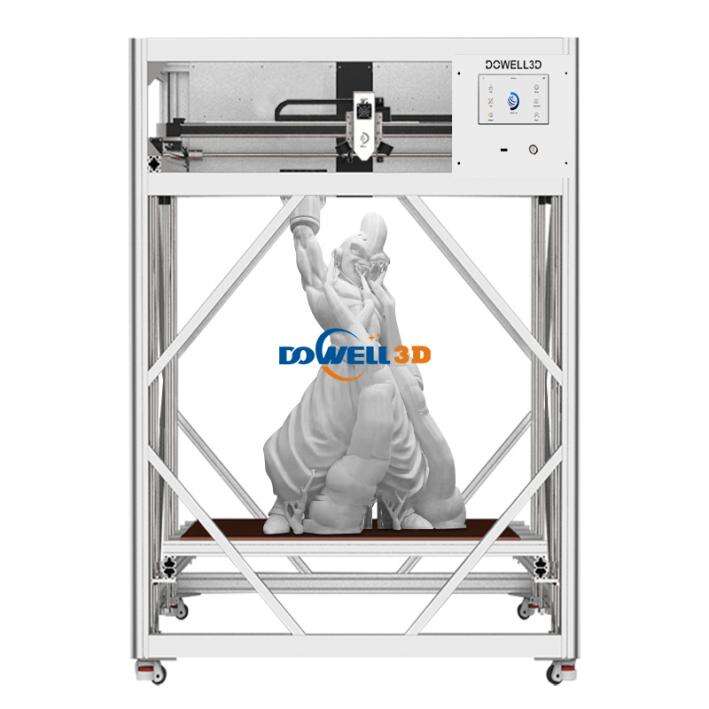
Efficiency is the new-day competitiveness in the hectic industrial world. To manufacturers and creators, making their supply chain lean is not an ambition, but a requirement. We have an observable case at Luoyang Dowell Electronics Technology Co, Ltd. where the implementation of the large-format 3D printing technology is radically changing the traditional supply chain models, pushing them to agility and resilience levels never seen before coupled with unmatched cost-effectiveness.
Restructuring Production Timelines and Prototyping
Conventional production processes have been characterized by long lead times particularly in the case of big or complicated parts. Bottlenecks can be caused by the demand of special tooling, molds, and several production processes. This is right in the path of large 3D printers. They reduce the production schedules drastically by allowing digital creation of large components in one cycle. Prototyping (or production in small batches) that were once a matter of weeks can be done in days. This has enabled companies to prototype designs very quickly, rapid testing of the perceived concepts under real world conditions and introduce products into the market at a pace that was not previously considered possible. Being able to make on-order allows shorter development cycles, and the reaction to market feedback is nearly instantaneous.
Inventory and Logistics Minimization
Inventory management and logistics is among the most significant effects of large-scale 3D printing. The traditional supply chain usually is based on storing large inventories of spare parts or components and thus, consumes capital and large warehouse space. Moreover, transportation of these heavy products throughout the world is expensive and is also a contributing factor to logistical complexity. In the case of distributed large-format 3D printing, the paradigm changes to not storing parts but having digital files. Anywhere in the globe, a replacement component to a section of an industrial device can be printed on-demand and anywhere. This will save a great deal of physical inventories, warehousing expenses and logistics. It also helps reduce the impact of disrupting the supply chain, since the production is not centred anymore, but instead can be shipment towards the point of requirement.
Breaking through Design Freedom and Part Consolidation
In addition to speed and logistics, large 3D printers give engineers unprecedented freedom in design. They have the ability to produce very large and complex lightweight geometries that can not be produced with subtractive processes, or can be produced expensively. This always results in high part consolidation - in which an assembly of several parts can be remodeled as one, large part printed at once. Such consolidation simplifies the supply chain itself: less individual items are required to be sourced, manufactured, quality-inspected, assembled, and stocked in inventory. The outcome would be a simplified bill of materials, a smaller number of steps to go through the production process and a final product that would be more dependable owing to the lack of assembly points.
In Luoyang Dowell Electronics Technology Co, Ltd., we are determined to deliver high-tech manufacturing solutions that would enable the businesses to exploit these transformative advantages. The concept of large-format 3D printing is not merely a machine, but it is a strategic weapon in the creation of a leaner, more agile and more resilient supply chain. Through adopting this technology not only are the companies streamlining their existing operations but also are futurizing their production to the increasingly unstable world.