
 EN
EN
 AR
AR
 BG
BG
 HR
HR
 DA
DA
 NL
NL
 FR
FR
 DE
DE
 EL
EL
 HI
HI
 IT
IT
 JA
JA
 KO
KO
 PT
PT
 RU
RU
 ES
ES
 SV
SV
 TL
TL
 ID
ID
 SR
SR
 SK
SK
 UK
UK
 VI
VI
 ET
ET
 HU
HU
 TH
TH
 TR
TR
 MS
MS
 GA
GA
 BE
BE
 HY
HY
 KA
KA
 LO
LO
 LA
LA
 MN
MN
 NE
NE
 SO
SO
 MY
MY
 KK
KK
 UZ
UZ
Closed-Loop Control & Reliability: What Makes a 3D Printer Truly Industrial in 2026
RAPID + TCT, North America's largest additive manufacturing event, moved to Boston for the first time in 2026: 450+ exhibiting companies, 160+ conference sessions, and engineers who came to buy capacity, not curiosity (SME, 2026). The venue changed, and so did the question on the floor. Nobody asked "what can this print?" They asked "will it print the same part at hour 60 as it did at hour 1?"
Wohlers Report 2026 values 2025 additive manufacturing revenue at $24.2 billion, up 10.9%. The growth split is the real signal: printing services grew 15.5%, machine sales only 3.6% (ASTM International, Feb 16, 2026). Industry is not buying machines to experiment. It is buying machines to produce.
That shift raises the bar for what an industrial 3D printer must prove in 2026. The proof is control, environment, and repeatability — not build volume.
What "Industrial" Means in 2026 — and What Changed
Production, not prototyping
Stratasys's 2026 predictions placed additive manufacturing firmly inside production workflows (Stratasys, Jan 22, 2026). Design News added the qualifier: throughput, process stability, and part consistency are what unlock production adoption (Feb 25, 2026). The threshold for calling a machine an industrial 3D printer is that it produces — day in, day out — rather than demonstrates.
Three Prerequisites for Production-Grade Additive Manufacturing (AM)
What exactly elevates a 3D printer to industrial-grade status? There are three rigorous criteria: stability and repeatability over thousands of hours of operation; a material range capable of producing functional parts; and environmental control capabilities that ensure the consistency of both the former factors. If a machine’s performance drifts after just 300 hours of operation, it cannot be considered industrial-grade equipment—at best, it is merely "over-enthusiastic."
Industrial is a duty class, not a size class
Large scale 3D printing gets the attention, but size is the least interesting variable. An industrial FDM 3D printer is defined by duty class — hours per day, parts per week, uptime — not by its envelope alone. 3DPrinting.com's 2026 large-format guide names duty cycle and reliability features — not build size — as the deciding factors at industrial scale (Jul 14, 2026). A large format 3D printer that runs two shifts a day is an asset; one that runs two shifts a week is an expensive toy.
Closed-Loop Control: The Difference Between Printing and Producing
Open loop vs closed loop
An open-loop machine sends a command and assumes it was executed. A closed loop 3D printer measures position, temperature, and feed while it works — and corrects in real time. DOWELL's DF series holds positioning accuracy within 0.02 mm across its travel; should a power outage occur, the braking motor locks instantly. The machine knows where it is, not just where it should be.
The 60-hour print
Long print reliability 3D printer features earn their keep at hour 40, not at the demo. A 60-hour job cannot be restarted from memory. 3DPrinting.com's guide lists AI fault detection, power-loss resume, and filament sensors as the features that separate usable machines at that scale (Jul 14, 2026). DOWELL builds them in as standard: filament sensor, visible temperature graph, auto-resume, and history records.
The second closed loop: heat
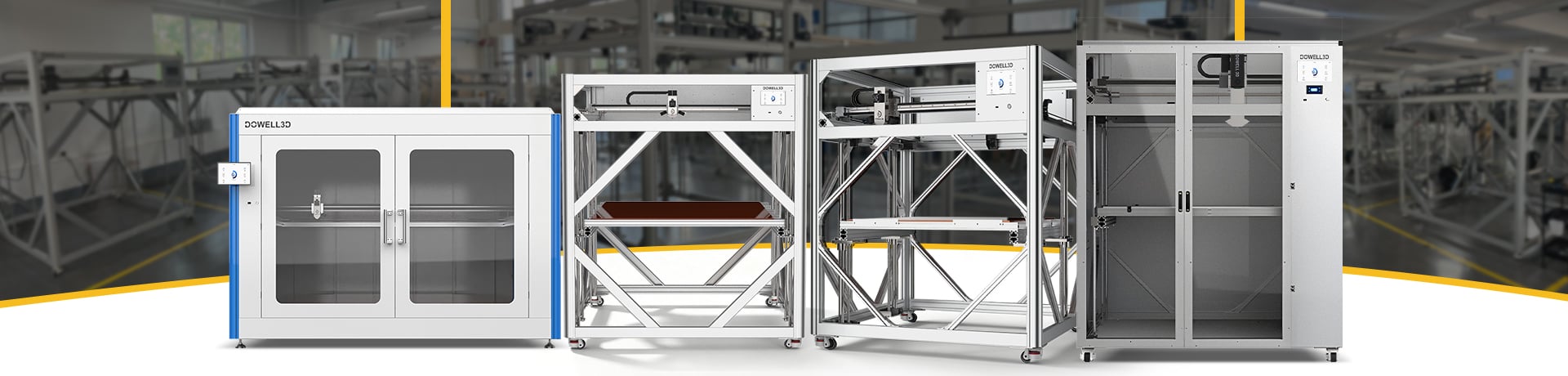
Thermal stability 3D printing is the second closed loop — and the one most machines get wrong. Engineering materials demand it: 3DPrinting.com's material guide notes polycarbonate needs a 45–65°C active chamber, a 100–120°C bed, and a 260–310°C hotend. That is why the DF series ships as a sheet-metal enclosure with precise temperature control and a 0–350°C hotend. For buyers comparing an industrial 3D printer with enclosure against an open frame, the chamber is not a luxury — it is the material envelope. The DF line covers 1000 × 1000 × 1200 mm (DF1010-12), 1200 × 1200 × 1200 mm (DF12), and 1600 × 1600 × 1200 mm (DF1616-12), all at a sustained 1,000 g/h throughput.
Reliability Is a Feature List, Not a Promise
The hour-58 failure test
Ask one question before buying: "At hour 58 of a 60-hour job, what protects the part?" 3D printer power loss resume used to be a convenience. At hour 58, it is the difference between a finished part and a pile of scrap. The DF series resumes from the exact layer, with a visible temperature graph and emergency stop as backup.
Enclosure as reliability hardware
The sheet-metal shell is not styling. It damps thermal drift, shields the motion system from dust and drafts, and turns a sensitive process into a repeatable one. Combined with closed-loop motion and brake motors, the enclosure is the cheapest insurance a printer can carry.
Redundancy and sensing
WiFi, camera, remote control — a camera pointed at a 300-hour job is management, not surveillance. Every DF unit ships with a 10-inch touchscreen, live status, and remote monitoring, so a failed layer is caught in minutes, not mornings.
What happens after the sale
Industrial 3D printer maintenance starts with the vendor, not the machine. DOWELL backs the DF series with a 12-month warranty and lifetime after-sale service, supported by 220+ technicians and 9,600+ cooperative customers accumulated over 12 years of manufacturing.
The Market Is Voting With Its Wallet
Wohlers numbers
The same Wohlers Report 2026 data shows Asia-Pacific AM companies grew revenue 19.8% in 2025, against 12.6% in the Americas and 9.0% in Europe, the Middle East, and Africa (ASTM International, Feb 16, 2026). Money follows machines that hold tolerances.
Show-floor signals
TCT Asia 2026 drew 44,519 visitors, up 42% year on year, with international attendance up 50% to 3,045 (TCT Asia, May 7, 2026). Buyers are specifying an industrial 3D printer for manufacturing — not for the showroom — and attendance tracks that intent.
What buyers ask now
The first questions are no longer about price. They are about duty cycle, uptime, spare parts, and calibration support. The strongest pull right now is a large format 3D printer for tooling — jigs, fixtures, forming aids — where one machine displaces an entire outsourced supply chain.
How to Evaluate an Industrial FDM 3D Printer
1. Control loop
Ask whether the controller measures or assumes. A closed loop control 3D printer answers with encoder feedback and temperature telemetry; an open-loop machine answers with hope.
2. Duty cycle
How many hours a day will it run, and at what throughput? A sustained 1,000 g/h matters more than a peak number. A high precision 3D printer for production duty should hold 0.02 mm positioning across a full shift.
3. Enclosure
Is the chamber sealed and thermally managed, or open to the shop floor? Sheet metal, closed-loop control, precise temperature control — the DF series checks all three.
4. Material envelope
Match the hotend to the material list. The DF hotend reaches 0–350°C, takes 2.85 mm filament across PETG, ABS, ASA, TPU, GF, CF, PC, and PA, and prints layer accuracy from 0.04 to 0.6 mm. A machine is only as useful as its material envelope.
5. After-sale
Warranty length, spare parts availability, and response time.
The Bottom Line
In 2026, an industrial 3D printer is a closed-loop, environmentally controlled, repeatable system. That is exactly what the DF series puts inside a sheet-metal body: closed-loop control, a 0–350°C hotend, 1,000 g/h sustained throughput, and the warranty to back it.
Send your part size and filament — DOWELL's engineers will tell you honestly which machine class fits, and why.