
 EN
EN
 AR
AR
 BG
BG
 HR
HR
 DA
DA
 NL
NL
 FR
FR
 DE
DE
 EL
EL
 HI
HI
 IT
IT
 JA
JA
 KO
KO
 PT
PT
 RU
RU
 ES
ES
 SV
SV
 TL
TL
 ID
ID
 SR
SR
 SK
SK
 UK
UK
 VI
VI
 ET
ET
 HU
HU
 TH
TH
 TR
TR
 MS
MS
 GA
GA
 BE
BE
 HY
HY
 KA
KA
 LO
LO
 LA
LA
 MN
MN
 NE
NE
 SO
SO
 MY
MY
 KK
KK
 UZ
UZ
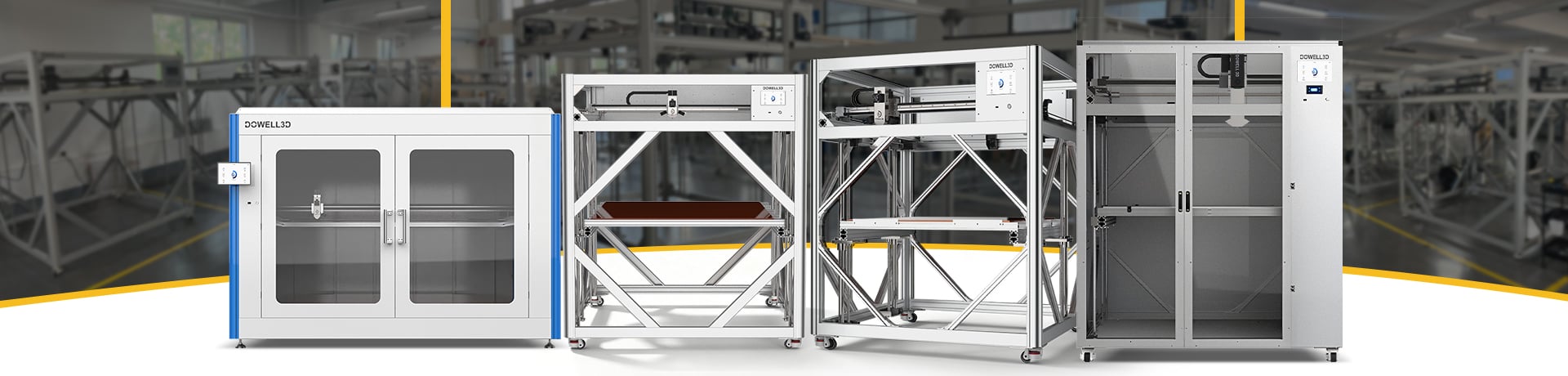
ABS vs ASA Large Parts: Enclosure, UV and Warp Control
Choosing between ABS and ASA is not a question about which polymer is better. On a full-size part the two run through the same machine at close to the same settings, and the property that separates them has nothing to do with the slicer. What decides the outcome is the environment the part is built in, the sunlight it will live under, and how deliberately you fight shrinkage across a metre of length. Settle those three, and the polymer chooses itself.
Print Behaviour: Close Enough to Interchangeable
Both are styrenic engineering polymers, supplied as 1.75mm and 2.85mm ABS and ASA filament across the range, and both run through the large machines' 0.8mm, 1.2mm and 1.6mm nozzles at temperatures well above their softening range. Tensile strength, stiffness and chemical resistance sit near enough that most industrial parts cannot tell them apart, and layer bonding between passes is strong in both, which is why a failed large part almost never delaminates along a layer. It lifts at a corner instead.
The practical differences are smaller than the chemistry suggests. ASA is the more tolerant of the two on the shop floor: it prints with a less aggressive odour, which matters when a 1,600mm machine runs for two days inside a working building. Neither polymer is difficult on a machine built for large parts. Both are difficult on a machine that leaves the part exposed to the room.
The Enclosure Question Is Really a Gradient Question
Warp begins the moment a freshly laid bead starts to cool while the layer beneath it has already stopped moving. The bead contracts; the layer below resists, and the difference turns into stress stored in the part. On a small part that stress spreads over a few centimetres and dissipates. On a large one the gradient runs the length of the build: by the time the upper layers go down, the first ones are hours old and sitting at room temperature.
So do I need an enclosure for ABS at this size? Yes, and for ASA too. The job of a closed cabinet is not to bake the part; it is to slow cooling and hold the air around the part steady so the gradient across it flattens. Our large machines take an optional 60°C enclosure and an optional heated bed up to 150°C, and the DF series adds a fully enclosed cabinet with precise temperature control. That is a stability aid rather than a soak. It buys forgiveness and shortens the window in which a cold draught can pull a corner off the bed. It does not remove the need for the geometry and adhesion work below.
One habit matters more than the number you set: keep the door closed for the whole build, and give the cabinet time to settle before the first layer. A draught at hour fourteen undoes what fourteen hours of stable air built.
UV Is the Reason to Pay for ASA
ABS vs ASA UV resistance is where the two genuinely part company. The rubber phase that toughens ABS is built on unsaturated bonds, and sunlight plus oxygen attack exactly those bonds. The surface chalks first, then discolours, and over a long exposure it embrittles. ASA replaces that phase with a saturated acrylic rubber that lacks the weak point, so colour and surface hold far longer under the same sun. Ultraviolet attack is a surface effect, but on a large part the surface is the product: what the buyer sees at handover and what the end user touches for years.
Two boundaries are worth stating plainly. The first is that pigments decide as much as the polymer does; a dark part hides a change that a light one shows early. The second is that UV resistance is not heat resistance. ASA does not buy a higher service temperature than ABS, and neither is the answer when a part must survive near an engine or inside a heated process. That is a different family of materials.
Warp Control Comes Before the Material Choice
Here is the uncomfortable part about abs vs asa printing settings: the levers that control warp are the same for both. Cooling, enclosure, bed temperature, adhesion and part orientation are set by the machine and the geometry, not by which of the two spools you loaded. Choose between the polymers in order to fix a warping part and you are reaching for the wrong lever.
What moves the outcome is decided before slicing. Keep to the numbers abs asa shrinkage large parts actually produce: 0.5-0.8% on cooling, which is 5 to 8mm per metre of length, so a rail or a hole pattern a couple of metres apart has to be compensated in the file rather than shimmed after the fact. Geometry works the same way — a long unbroken wall and a heavy cross-section both give contraction more to pull against — but neither polymer is exempt, and neither is favoured. The file decides; the polymer does not.
ABS or ASA in One Minute
Choosing abs or asa for a large cabinet takes a minute once you know where it will live. Where the need is asa for outdoor 3d printed parts, choose ASA: sun-facing panels, signage, housings, anything that weathers visibly or spends years under ultraviolet light. For an indoor fixture, a jig, a machine cover or a part that will be painted anyway, ABS does the same job for less money per kilo. Where the answer is genuinely close, ask what the customer will see in two years rather than what the datasheet promises.
Because both run on the same hardware, a shop that prints both does not need two machines. For any large format 3d printer abs asa decision, size the envelope first and treat the filament as a line item.
Questions Buyers Ask Before Choosing
Can one machine print both?
Yes. Both are stocked as filament and run in the same temperature window, so switching between them is a spool change rather than a machine change.
Does ASA stop a large part from warping?
No. ASA buys weathering, not dimensional stability. Its shrink behaviour on cooling sits in the same band as ABS, so a part that warps in ABS will still warp in ASA.
Do I need a heated chamber or is an enclosure enough?
For most parts an enclosure is enough, and a stable cabinet is what our range offers as an option. A tall thin section is a geometry problem first: orientation and adhesion will decide it long before chamber temperature does.
Is ASA worth the higher price?
It is worth it where ultraviolet light reaches the part and the surface matters. Indoors, behind a paint coat, or inside a machine, the premium buys nothing you will notice.
What if the part is both outdoor and large?
Then settle the mechanics before the polymer: the geometry, the shrinkage compensation, and a closed cabinet for the whole build. Material choice comes after those, and for that combination it points to ASA.
Conclusion
ABS and ASA are close cousins: one is cheaper; the other keeps its appearance in sunlight. Neither one will save a part that is fighting its own cooling. Send us the span, the wall thickness and where the part will live, and we will tell you which of the two we would load, and what we would change in the file first.