
 EN
EN
 AR
AR
 BG
BG
 HR
HR
 DA
DA
 NL
NL
 FR
FR
 DE
DE
 EL
EL
 HI
HI
 IT
IT
 JA
JA
 KO
KO
 PT
PT
 RU
RU
 ES
ES
 SV
SV
 TL
TL
 ID
ID
 SR
SR
 SK
SK
 UK
UK
 VI
VI
 ET
ET
 HU
HU
 TH
TH
 TR
TR
 MS
MS
 GA
GA
 BE
BE
 HY
HY
 KA
KA
 LO
LO
 LA
LA
 MN
MN
 NE
NE
 SO
SO
 MY
MY
 KK
KK
 UZ
UZ
Large Scale 3D Printer Performance: Speed, Size and Accuracy
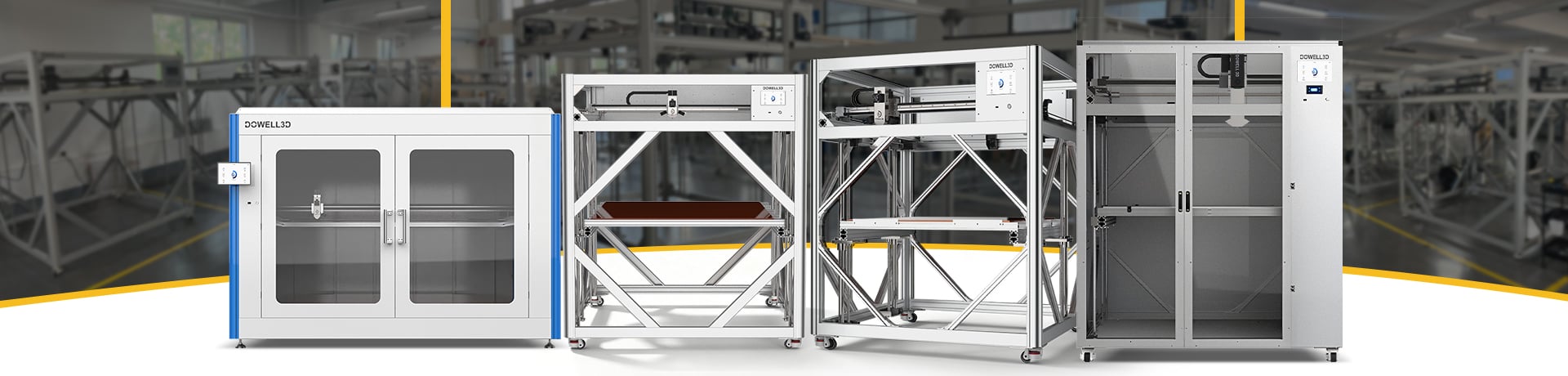
DOWELL's largest build volume (Model DL1824-16) measures 1,800 × 2,400 × 1,600 mm. This model features a robust 80 cm thick aluminum alloy frame, a high-speed printing capability of 500 mm/s, and a high-precision automatic leveling system, ensuring an optimal balance of speed, size, and accuracy.
Size, speed, and accuracy are typically presented as three independent specifications; however, in large-format 3D printers, they share the same "budget"—meaning they are mutually constraining resources. Improving one aspect often requires compromising on the other two.
The following section explains the mechanics of this "budget" and provides guidance on how to prioritize these three metrics based on your specific production requirements.
Three Specs, One Budget
No industrial 3d printer holds all three at full strength. A 0.02mm positioning figure measured across 300mm of travel and the same figure held across 2,400mm are not the same achievement wearing different numbers.
Stiffness, moving mass, and travel all grow with the envelope, while the frame section and motor torque have to grow faster to hold the same result. That is the trilemma in one sentence: any two can be bought, and the third becomes the compromise. Pair a big envelope with tight tolerance and speed is what you surrender. Pair speed with tight tolerance and the envelope stays modest. Envelope and speed together, though, leave accuracy as a relative term.
Why Size Multiplies Print Hours Faster Than the Envelope Grows
The 3d printer build volume is what a buyer reads off a spec sheet. Filament is what the machine lays down, and that scales with the cube. Scale a part up by half — from the 1,200mm envelope to the 1,800mm one — and the same geometry carries 3.4 times the filament.
Melt rate is a property of the hotend, not the frame. The DOWELL DMplus series tops out near 400 grams an hour; the DMpro, DL, and DF machines hold 1,000; the DP-A screw extruder, fed with pellets rather than strand, reaches 4,000-5,000. Enlarge the envelope and the ceiling on deposition stays where it was.
So what does a large format 3d printer actually buy? Not a faster second. It buys a part in one piece. A full-size shell printed in a single run replaces four segments joined, aligned, and finished — hours of work, plus a seam wherever it happens.
Travel Distance Is the Tax on Accuracy
Angular error turns into linear error in proportion to distance. One arc-minute of misalignment — invisible to a visual check — displaces the nozzle by 0.47mm across 1,600mm of travel, and 0.06mm across 200mm. Nothing about the machine changed. The envelope did.
Thermal growth follows the same rule. Steel lengthens by roughly 12 micrometres per metre for each degree Celsius, so a 1,800mm frame drifts about 0.065mm through a three-degree shop swing, while a 300mm frame drifts 0.011mm. One number printed on two spec sheets, and only one of them is still true after the shop warms up.
Which is why a 0.02mm claim means nothing until it arrives with a distance and a temperature. A large format 3d printer that answers both is describing a build; one that answers neither is describing a brochure.
Deflection Grows With the Third Power of the Span
A beam supported at both ends sags with the cube of the unsupported length: double the span and the middle drops eight times as far at the same section. That is the arithmetic behind every thick frame in this class, and the reason an 80mm heavy-duty frame sits under the DL series.
Scale that to a carriage holding position to hundredths of a millimetre more than a metre from its bearings, and stiffness has to come from somewhere: steel section adds mass, mass adds the force to move it, and that force lands back on the frame. Brake motors on the same axes hold position when the carriage stops, so gravity gets no vote between moves.
Where a Big Machine Gains Speed, and Where It Cannot
Two levers set how fast a large part finishes: how much the hotend can melt, and how coarse the bead is allowed to be. Both are decisions about the part.
A full-size shell that will be sanded, painted, or bonded rarely needs a fine skin, so it can run a 1.2mm or 1.6mm filament bore, or the 3.0mm pellet bore, and lay a deep layer. A mating face on the same part cannot. That is the speed-accuracy trade in practice: the wide bore is quick and coarse, and coarse is a tolerance cost on any surface that has to meet another one.
Positioning accuracy is only one of three accuracy inputs at this scale, and often it is not the largest. Shrinkage is the second: ABS and ASA contract by roughly 0.5-0.8% as they cool, which is invisible on a 20mm bracket and decisive on a full-size shell where bolt holes 1,500mm apart land up to 12mm from where the file put them. The third is the bead itself, which cannot resolve a feature finer than its own width. A high precision 3d printer with a 0.02mm axis still misses a fit if those two inputs are left unmanaged.
Ranking Size, Speed and Accuracy by Workpiece
Start where tolerance is not the issue: full-size shells, patterns, and tooling. A generous band is acceptable on all three and the widest bore is available, so envelope and melt capacity decide the machine. Add a frame that resists deflection and the list is complete — fine tolerance is not the deciding line here.
Fixtures, jigs, and mating assemblies invert that. Interchangeability is the test — the tenth part has to fit the first — and the fasteners have to line up, so closed-loop control and a positioning figure stated over a distance outrank extra envelope. Their natural home is a moderate build size, not the largest one on the floor.
Batched detail parts pull the other way: a fine bore, a modest envelope, and speed ranked first. Fine bores and big envelopes fight each other — every crisp feature narrows the bead and every thin layer lengthens the job. Detail belongs on the smaller machine; full-size parts belong on the large one.
Only one-off mid-size production calls for balance: a mid-size envelope, the middle of the melt range, and a tolerance band quoted in millimetres rather than hundredths.
The Bottom Line
One machine cannot be strong on all three at once: the same frame, mass, and travel carry the bill. A large scale 3d printer buys a part in one piece, and charges hours for it — plus a tolerance band that widens with every metre of travel.
Our workshop covers 12,000 m² and we have spent more than 12 years building these machines; 220+ technicians support 9,600+ cooperative customers — long enough to know which of the three a given job actually needs.
Send us the part, its critical dimensions, and the quantity — our engineers will come back with the model and the tolerance band they would quote.