
 EN
 AR
 BG
 HR
 DA
 NL
 FR
 DE
 EL
 HI
 IT
 JA
 KO
 PT
 RU
 ES
 SV
 TL
 ID
 SR
 SK
 UK
 VI
 ET
 HU
 TH
 TR
 MS
 GA
 BE
 HY
 KA
 LO
 LA
 MN
 NE
 SO
 MY
 KK
 UZ
Large 3D Printing Design Tips for Stronger Functional Parts
Designing a large 3D-printed part involves more than increasing its dimensions in CAD software. As part size grows, factors such as layer adhesion, wall thickness, print orientation, and material shrinkage can have a greater impact on the final result. For manufacturers using a large format 3D printer, good design decisions can reduce printing failures, improve mechanical performance, and save production time.
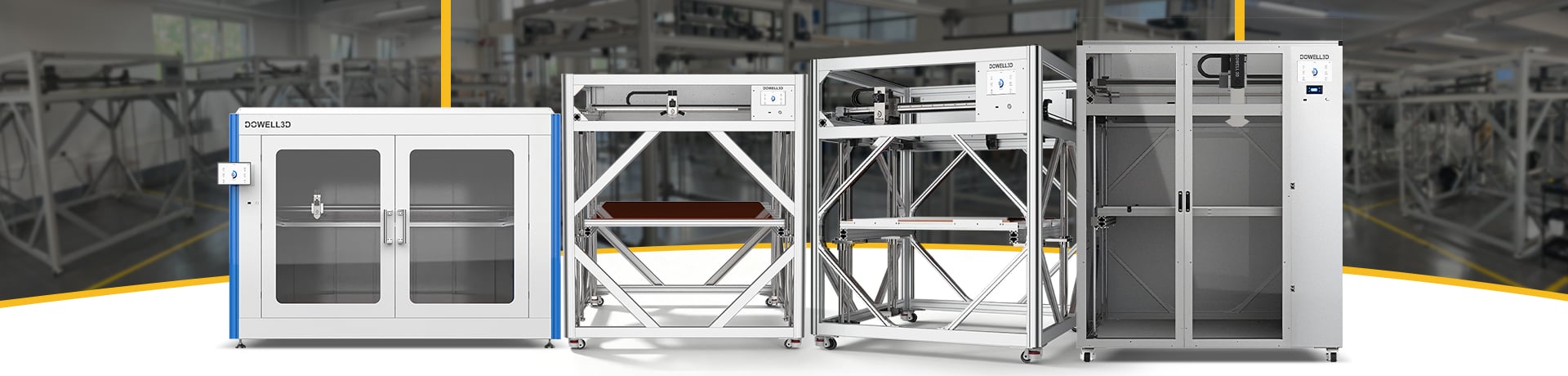
At DOWELL, we develop and manufacture industrial-grade FDM 3D printers and FGF pellet 3D printing systems for large-scale manufacturing. Here are five practical design tips to help you create stronger, more reliable functional parts.
1. Choose the Right Print Orientation
Print orientation directly affects how a 3D-printed part withstands loads. FDM parts are generally anisotropic, meaning their strength can vary by direction of applied force and layer arrangement.
When designing load-bearing components, avoid placing critical tensile loads across layer interfaces whenever possible. Orient the part so continuous printed paths support the main forces rather than relying entirely on interlayer bonding.
For oversized components, the best orientation should also consider support requirements, build volume, and printing time.
2. Optimize Wall Thickness and Internal Structure
Adding more material does not always produce a stronger part. Excessive wall thickness can increase printing time, material consumption, and residual stress.
Instead, focus on the areas that carry the most load. Increase wall thickness around mounting holes, connection points, and stress concentration zones. Use ribs, gussets, and curved transitions to distribute forces more evenly.
For large-format 3D printing, these structural features can improve stiffness without making the entire part unnecessarily heavy. In some applications, a carefully designed internal structure delivers a better strength-to-weight ratio than simply increasing infill density.
3. Select Materials Based on Real Working Conditions
Material selection should start with the part's intended use, not just the easiest material to print.
PLA: Suitable for visual prototypes, concept models, and parts with limited heat exposure.
ABS: A practical option for functional housings and components requiring impact resistance and improved heat tolerance.
PETG: Offers a useful balance of toughness, chemical resistance, and ease of printing.
Nylon and fiber-reinforced materials: Worth considering for demanding applications that require specific mechanical properties, provided the printer supports the material.
When choosing material for an industrial-grade 3D printer, also consider shrinkage, moisture sensitivity, processing temperature, and interlayer adhesion. For large parts, these factors can affect dimensional accuracy as well as strength.
4. Design for Thermal Control and Dimensional Stability
Large parts are more susceptible to warping because different regions may cool at different rates. This is particularly important when using materials such as ABS or other engineering thermoplastics.
Where possible, avoid abrupt changes in wall thickness, oversized flat surfaces, and sharp internal corners. Rounded transitions and more uniform cross-sections can help reduce stress concentrations and uneven cooling.
Designers should also account for material shrinkage and allow sufficient clearance for assembled components. A large 3D printing machine may offer an impressive build volume, but accurate results still depend on material behavior, temperature management, and machine calibration.
5. Match Your Design to the Printing Technology
A part designed for a small desktop 3D printer may not be optimized for a large industrial system. Higher material throughput, longer print durations, and larger build areas introduce different design considerations.
For FDM printing, filament feeding and nozzle performance influence the achievable geometry and deposition rate. For FGF pellet 3D printing, pellet properties, extrusion stability, nozzle diameter, and bead width become especially important.
If your project involves oversized molds, automotive prototypes, furniture, sculptures, or industrial tooling, designing around the capabilities of a suitable large-format 3D printer can help balance strength, surface quality, and production efficiency.
Build Stronger Parts with DOWELL Large-Format 3D Printers
Strong functional parts begin with the right design, but the printing system matters just as much. DOWELL develops and manufactures large-format 3D printers, industrial-grade FDM systems, and FGF pellet 3D printers for businesses that need to produce large components efficiently.
Whether you are developing functional prototypes, manufacturing molds, or printing customized industrial parts, our team can help you explore a suitable large 3D printing machine for your application.
Looking for an industrial 3D printer for large functional parts? Contact DOWELL to discuss your project, material requirements, and production goals.