
 EN
EN
 AR
AR
 BG
BG
 HR
HR
 DA
DA
 NL
NL
 FR
FR
 DE
DE
 EL
EL
 HI
HI
 IT
IT
 JA
JA
 KO
KO
 PT
PT
 RU
RU
 ES
ES
 SV
SV
 TL
TL
 ID
ID
 SR
SR
 SK
SK
 UK
UK
 VI
VI
 ET
ET
 HU
HU
 TH
TH
 TR
TR
 MS
MS
 GA
GA
 BE
BE
 HY
HY
 KA
KA
 LO
LO
 LA
LA
 MN
MN
 NE
NE
 SO
SO
 MY
MY
 KK
KK
 UZ
UZ
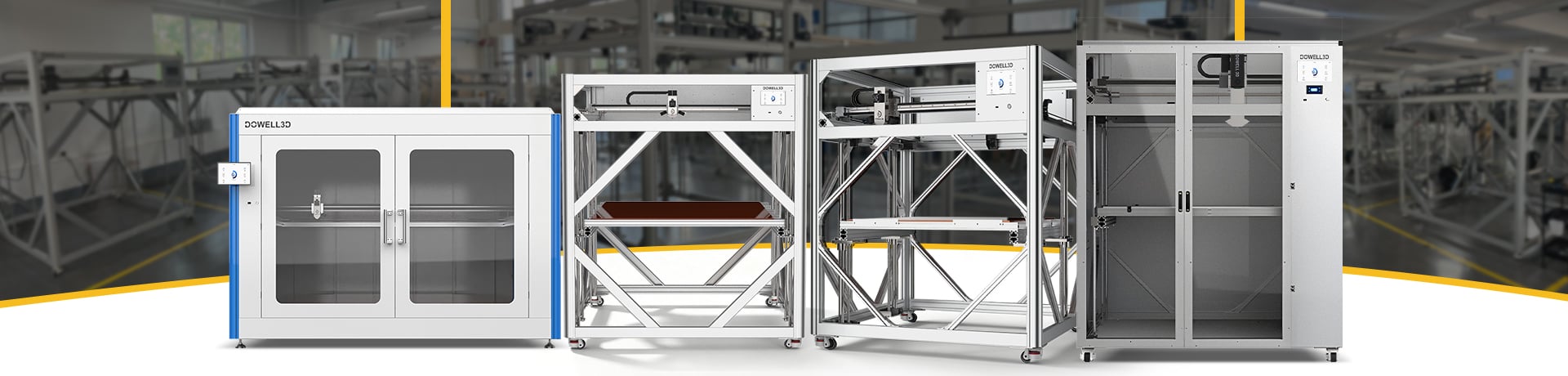
Large 3D Printer Frame Rigidity: Why It Matters Most
When purchasing a large-scale professional-grade 3D printer, many users tend to focus on printing speed, build volume, or software functions. However, there is an often-overlooked factor that directly affects print quality, and that is the rigidity of the frame.
For large-format printing applications, the structure of the machine is critical. If the frame is not rigid enough or stable, it may cause vibration, dimensional deviation, poor surface quality, and inconsistent print results.
Especially for users who need large-format 3D printers for industrial production, a strong and rigid mechanical structure is not only an advantage but also an essential condition.
What Is Frame Rigidity in a 3D Printer?
Frame rigidity refers to the ability of the 3D printer structure to resist displacement, vibration, and deformation during operation.
When the printer moves at high speeds, handles large models, or runs continuously for long periods of time, the rigid frame ensures the stability of the printing system.
For professional-grade industrial 3D printers, frame rigidity affects many key factors:
Printing accuracy
Alignment between layers
surface quality
Long-term stability
Equipment durability
Simply put, the more stable the frame structure, the more stable and consistent the printing performance will be.
Why Frame Rigidity Matters More for Large Format 3D Printers
Small desktop 3D printers are typically compact, so the effects of vibration are relatively limited.
However, large-format 3D printers face tougher challenges because:
Larger moving components
Heavier print heads
Bigger build platforms
Longer printing times
Higher mechanical loads
As equipment increases in size, even small vibrations can become significant.
For example, over the course of a 30-hour printing process, subtle mechanical displacements may gradually affect inter-layer accuracy and the quality of the final part.
Because of this, professional-grade large-format printing systems need to have a more solid mechanical structural foundation.
How Poor Frame Rigidity Affects Print Quality
1. Reduced dimensional accuracy
Many industrial applications require precise dimensions. Even small deviations can affect assembly, testing, or the performance of the final product.
An insufficiently rigid rack may result in:
Incorrect measurements
Misaligned layers
Deformed edges
Inconsistent part dimensions
For industries that require high-precision components, high-precision 3D printers must have a sturdy structure to ensure reliable printing results.
2. More Visible Vibration Patterns
When the printer moves at high speed, vibration can appear as surface defects on printed parts.
Common issues include:
Ringing or ghosting marks
Uneven surfaces
Layer inconsistencies
A rigid frame reduces unnecessary movement, allowing the print head to follow the designed path more accurately.
3. Low long-term reliability
Industrial users often need to run printers for long periods of time.
Equipment with poor structural stability may suffer from the following problems:
Increased mechanical wear
Need to adjust more frequently
Reduced production efficiency
For businesses that rely on continuous operations, structural reliability is as important as print performance.
Key Design Features of a Rigid Large 3D Printer Frame
Heavy-Duty Structural Materials
A professional large-format machine usually requires a strong frame made from durable materials.
A stable structure helps reduce deformation caused by:
High-speed movement
Heavy components
Continuous operation
This creates a stronger foundation for accurate printing.
Strengthen mechanical design
Large equipment requires not only simple size enlargement, but also reasonable structural strengthening.
A well-designed industrial 3D printer typically focuses on:
Stable rack connection
Reduce mechanical movement
Balanced weight distribution
Optimized vibration control
These details help ensure the device maintains consistent performance in high-intensity applications.
Stable Motion System
The frame and motion system work together.
Even with advanced control systems, unstable mechanical movement can limit final accuracy.
A rigid structure allows:
Smoother movement
More accurate positioning
Better repeatability
This is especially important when producing large functional parts.
Why High Precision Printing Depends on Mechanical Stability
Many users assume that printing accuracy mainly depends on software or resolution settings. While these factors are important, mechanical stability creates the foundation for precision.
A high precision 3d printer requires:
Accurate motion control
Stable temperature management
Strong mechanical structure
Reliable calibration
Without a rigid frame, even advanced technology cannot fully achieve consistent accuracy.
How to Choose a Large 3D Printer With Better Frame Rigidity
When evaluating a professional 3D printer, consider these questions:
Is the machine designed for continuous operation?
Industrial applications require equipment that can maintain stability during long printing cycles.
Can the structure handle large-scale printing?
A larger build volume requires stronger mechanical support.
Does the design focus on accuracy and repeatability?
For professional manufacturing, consistent results are more valuable than occasional successful prints.
Dowell 3D focuses on developing large-format printing solutions with strong mechanical structures, helping users achieve stable performance for industrial applications, large prototypes, and functional parts.
Conclusion
Frame rigidity is one of the most important factors that determines the performance of a large 3D printer.
A strong and stable structure improves accuracy, reduces vibration, and supports reliable long-term operation.
For businesses investing in a large-format 3D printer or industrial 3d printer, choosing a machine with excellent frame rigidity can make a significant difference in productivity and print quality.
A powerful printer is not only about size — it is about having a stable foundation that delivers consistent results every time.