
 EN
EN
 AR
AR
 BG
BG
 HR
HR
 DA
DA
 NL
NL
 FR
FR
 DE
DE
 EL
EL
 HI
HI
 IT
IT
 JA
JA
 KO
KO
 PT
PT
 RU
RU
 ES
ES
 SV
SV
 TL
TL
 ID
ID
 SR
SR
 SK
SK
 UK
UK
 VI
VI
 ET
ET
 HU
HU
 TH
TH
 TR
TR
 MS
MS
 GA
GA
 BE
BE
 HY
HY
 KA
KA
 LO
LO
 LA
LA
 MN
MN
 NE
NE
 SO
SO
 MY
MY
 KK
KK
 UZ
UZ
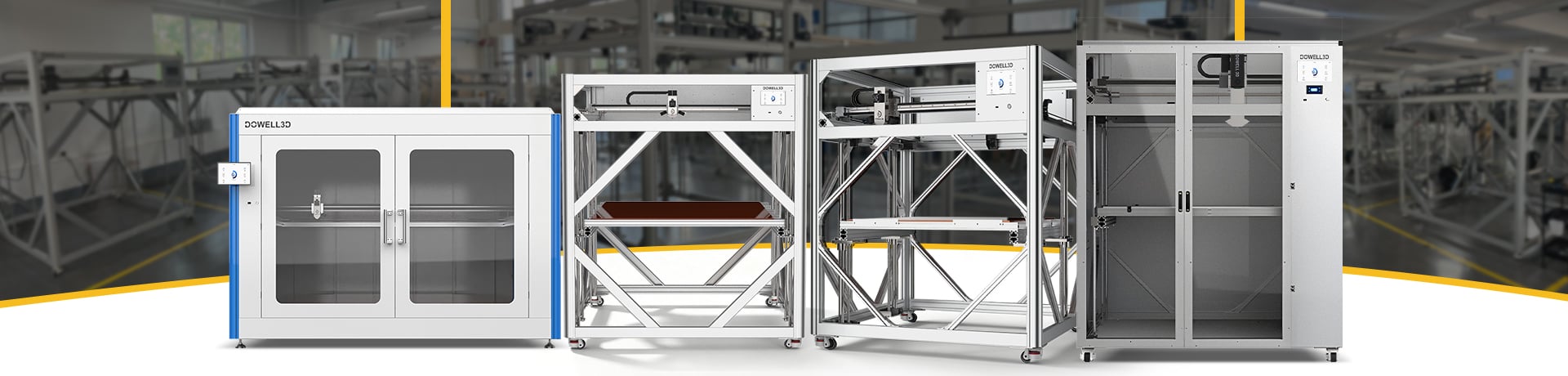
Large Format 3D Printer: How Does It Work?
As manufacturers continue to adopt additive manufacturing, the demand for large format 3D printers is growing across industries such as automotive, aerospace, architecture, education, and product development. Printing larger parts in one piece saves assembly time, improves structural strength, and speeds up production.
But how does a large format 3D printer actually work? Is it simply a larger version of a desktop machine, or is there more behind its design?
In this guide, we'll explain how a large-format printer operates, the key components that affect performance, and why choosing the right machine matters for professional applications.
What Is a Large Format 3D Printer?
A large format 3D printer is an additive manufacturing system with a significantly larger build volume than a standard desktop printer. Instead of producing small prototypes, it can manufacture full-size functional parts, molds, tooling, fixtures, and engineering prototypes in a single print.
The biggest advantage isn't just size—it's the ability to reduce assembly, improve part strength, and increase production efficiency.
How Does a Large Format 3D Printer Work?
Like most fused deposition 3D printers, a large-format machine builds an object layer by layer.
Here's how the process works:
Step 1: Create a 3D Model
Everything starts with a digital CAD model. The design is exported as an STL or other compatible file format before being imported into slicing software.
The slicer converts the model into thousands of printable layers and generates the machine instructions.
Step 2: Load the Filament
The printer feeds filament into the extrusion system.
As the filament passes through the heated nozzle, it melts to the required temperature and is deposited onto the build platform following the programmed toolpath.
Each new layer bonds to the previous one until the part is complete.
Step 3: Precision Motion Control
The print head moves along the X and Y axes, while the build platform or gantry controls movement on the Z axis.
Professional machines use rigid frames, precision motion systems, and advanced controllers to ensure smooth, repeatable movement throughout the print.
This is especially important on large machines, where even minor vibration can affect dimensional accuracy.
Step 4: Layer-by-Layer Manufacturing
Unlike subtractive manufacturing, which removes material, additive manufacturing builds the part one layer at a time.
This process allows manufacturers to produce:
Large prototypes
Functional components
Manufacturing fixtures
Architectural models
Custom tooling
End-use parts
without extensive machining or complex assembly.
Why Build Volume Matters
One of the defining characteristics of a large format 3D printer is its expanded build area.
Printing a large component as one piece offers several advantages:
Fewer assembly steps
Stronger finished parts
Better dimensional consistency
Shorter production times
Lower labor costs
For manufacturers producing oversized components, this can significantly improve workflow efficiency.
Key Components That Affect Performance
Not all large-format printers perform the same. Several mechanical systems determine print quality and reliability.
Rigid Frame
A strong metal frame minimizes vibration and helps maintain accuracy during long print jobs.
Motion System
High-quality linear rails and precision guides ensure smooth movement across the entire build area.
Extrusion System
Consistent material flow is essential for producing uniform layers and reliable surface quality.
Heated Build Platform
A stable heated bed improves first-layer adhesion and supports successful printing of large components.
Intelligent Control System
Modern control systems manage motion, temperature, and extrusion simultaneously, helping the printer maintain consistent performance during extended production runs.
How a High Precision 3D Printer Maintains Accuracy
Printing large parts requires more than simply increasing machine size.
A high precision 3D printer combines several design elements to maintain accuracy across the entire build volume.
These include:
Rigid structural design
Stable motion control
Accurate temperature management
Consistent extrusion
Reliable calibration
Together, these systems help reduce dimensional errors and improve repeatability, even during multi-day print jobs.
Choosing the Right Large Format 3D Printer
When comparing different machines, don't focus only on build volume.
Other important considerations include:
Frame rigidity
Motion system quality
Printing accuracy
Build platform stability
Filament compatibility
Ease of maintenance
Technical support
Long-term reliability
A balanced machine often delivers better results than one that simply offers the largest printing area.
Manufacturers such as Dowell 3D place equal emphasis on structural strength, precision motion, and dependable operation, helping professional users achieve consistent performance on large-scale projects.
Is a Large Format 3D Printer Right for You?
If your business regularly produces oversized prototypes, manufacturing tools, or functional components, upgrading to a large format 3D printer can improve productivity and reduce production costs.
Instead of dividing large models into multiple sections, you can manufacture complete parts in a single operation, saving time while improving overall part strength.
For companies looking to scale production, an industrial 3D printer also offers the durability and reliability needed for continuous operation.
Conclusion
A large format 3D printer works much like a standard 3D printer, but every component—from the frame and motion system to the extrusion and control electronics—is engineered to handle larger parts with greater precision.
Understanding how these systems work together makes it easier to choose the right equipment for your business. Whether you're producing prototypes, tooling, or end-use components, investing in a well-designed high precision 3D printer can improve efficiency, reduce waste, and support long-term production goals.