
 EN
EN
 AR
AR
 BG
BG
 HR
HR
 DA
DA
 NL
NL
 FR
FR
 DE
DE
 EL
EL
 HI
HI
 IT
IT
 JA
JA
 KO
KO
 PT
PT
 RU
RU
 ES
ES
 SV
SV
 TL
TL
 ID
ID
 SR
SR
 SK
SK
 UK
UK
 VI
VI
 ET
ET
 HU
HU
 TH
TH
 TR
TR
 MS
MS
 GA
GA
 BE
BE
 HY
HY
 KA
KA
 LO
LO
 LA
LA
 MN
MN
 NE
NE
 SO
SO
 MY
MY
 KK
KK
 UZ
UZ
Large Format 3D Printer Heated Chamber: Why It Matters
You've been there. You slice a big part, hit print, walk away, and come back 30 hours later to find the corners peeled up off the bed. Or worse — the whole thing cracked right down the middle.
If you're printing large parts on a large format 3D printer, this isn't bad luck. It's physics. And the solution — a heated chamber — is one of the most overlooked features when people shop for an industrial 3D printer.
Let's talk about why it actually matters.
The Problem: Big Parts Cool Unevenly
Here's what's happening inside your printer. As each layer of filament goes down, it's hot — around 200–300°C depending on the material. Then it starts cooling immediately. That's normal. But on a large part, the cooling isn't uniform.
The bottom layers near the heated bed stay warm longer. The top layers cool faster. The edges cool faster than the center. Everywhere there's a temperature difference, there's stress building up inside the plastic. And when that stress exceeds the strength of the material, something gives — warping, delamination, or cracking.
On a small 50 mm part, these stresses are manageable. On a 500 mm part, they're devastating. The distortion gets amplified across the larger distance. That 0.1% shrinkage you barely noticed on a calibration cube becomes a 0.5 mm error on a production part.
A heated chamber solves this by keeping the entire build environment warm and stable. It slows down the cooling rate so the whole part cools more evenly. Less temperature gradient = less internal stress = less warping.
What a Heated Chamber Actually Does
Think of it as climate control for your print. Instead of your part being at the mercy of room temperature, drafts, and opening doors, the chamber maintains a consistent thermal environment from first layer to last.
Here's what that gives you:
Better layer adhesion. When each new layer goes down onto a still-warm previous layer, the bond is stronger. The plastic fuses more completely. Some manufacturers report part strength improvements of up to 20% with a stable chamber temperature.
Dimensional accuracy. Parts come out closer to your CAD model because they're not shrinking and distorting as they cool. If you're printing functional parts that need to fit with other components, this is huge.
Reliability. Large prints take time — sometimes days. A heated chamber removes one of the biggest variables that can cause a print to fail at hour 35. You're not gambling on whether a draft from the HVAC system will ruin your part.
Wider material compatibility. This is where it gets really interesting.
Materials That Demand a Heated Chamber
Not all filaments need a heated chamber. PLA prints fine in open air. PETG is pretty forgiving. But once you move into engineering-grade materials, the game changes.
ABS is the classic example. It has a high thermal expansion coefficient and shrinks significantly as it cools. Without a heated chamber, large ABS parts are notoriously difficult — corners lift, layers split, and warping is almost guaranteed. With a chamber at 60–80°C, ABS becomes reliably printable.
Nylon is another material that benefits enormously from a warm environment. It's hygroscopic and sensitive to temperature changes. A heated chamber keeps it stable throughout the print.
ASA — essentially ABS with better UV resistance — has similar requirements.
And if you're working with high-temperature engineering filaments like polycarbonate or PEEK, a heated chamber isn't optional — it's mandatory. Some industrial machines run chambers at 90°C, 180°C, or even 195°C. Without that thermal control, these materials simply won't print successfully at any meaningful size.
For a large-format 3D printer that's meant to handle production work, material flexibility is everything. You don't want a machine that's limited to PLA and PETG when your application calls for something tougher.
Active vs. Passive Heating: What's the Difference?
Not all heated chambers are created equal.
Passive heating relies on the heat generated by the heated bed and hotend. The enclosure traps that heat, and the chamber temperature rises gradually. It's better than nothing, but it's slow and inconsistent. The temperature fluctuates with the print cycle, and you can't dial in a specific temperature for different materials.
Active heating uses dedicated chamber heaters with temperature sensors and closed-loop control. You set a target temperature — say, 70°C for ABS — and the system maintains it throughout the print. Pre-heating the chamber before the print even starts is another major advantage.
For an industrial 3D printer running critical parts, active heating is the way to go. It gives you repeatability, predictability, and the ability to dial in optimal settings for each material.
What to Look For in a Heated Chamber
If you're comparing large format 3D printers, here are the specs that actually matter:
Maximum chamber temperature. What's the ceiling? 60°C handles ABS and nylon. 80–90°C covers most engineering materials. If you need high-temperature filaments, look for 150°C or more.
Temperature uniformity. A chamber that's 80°C at the top and 60°C at the bottom isn't really 80°C. Look for machines with airflow control that distributes heat evenly throughout the build volume.
Pre-heating capability. Can you heat the chamber before the print starts? This matters for materials like ABS that need a warm environment from layer one.
Insulation. A well-insulated chamber holds temperature more efficiently and puts less heat stress on the electronics outside the chamber.
Filtration. If you're running engineering materials in a heated chamber, you're also dealing with fumes. Integrated HEPA and activated carbon filtration is a smart addition.
The Bigger Picture: Why This Matters for Production
Here's the thing about a large format 3D printer: you're not buying it to print calibration cubes. You're buying it to produce actual parts — tooling, fixtures, prototypes, end-use components. Those parts need to work. They need to be strong, accurate, and repeatable.
A heated chamber isn't a luxury feature. It's a prerequisite for reliable large-format printing with engineering materials. Without it, you're fighting the physics of cooling plastic every single print. With it, you're controlling the environment instead of being controlled by it.
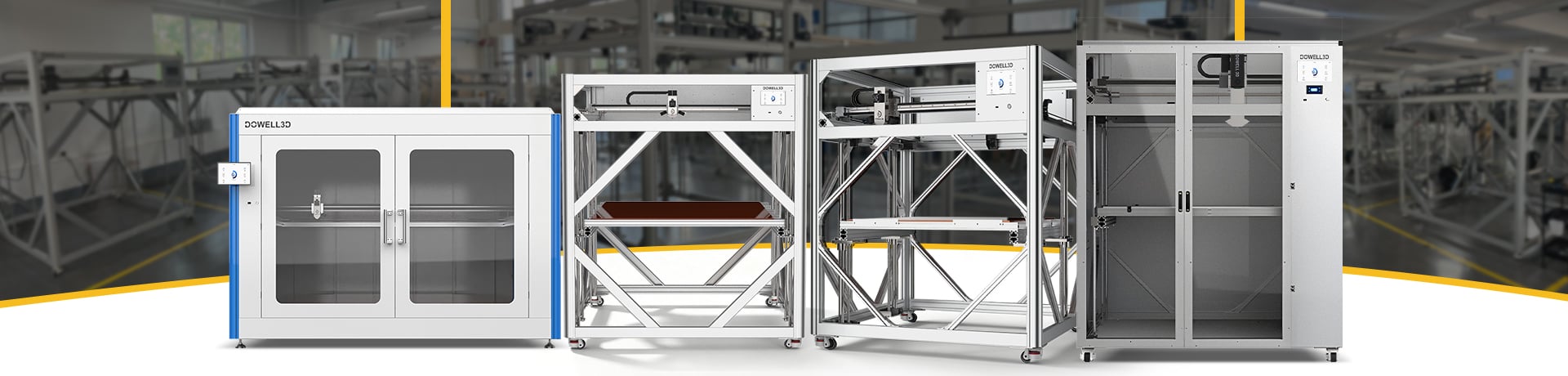
At DOWELL 3D, we design our large-format machines with active heated chambers across our DL Series, DM PLUS Series, and DM PRO Series — because we know that temperature control is what separates a hobby machine from a production tool. Our DL Series, for example, features high-temperature nozzles up to 420°C and customizable heated beds up to 150°C, engineered to handle advanced filaments like ABS, nylon, and carbon-fiber composites with minimal warping. It's the kind of capability that lets you focus on what you're making, not on whether your print will survive the night.